ChatGPT vs Claude for Business: Which Should You Actually Use?
GPT-5 and Claude Sonnet 4.5 sit at the top of independent benchmarks — but they win at different things. The honest answer to "which one" depends on what you need them to do.
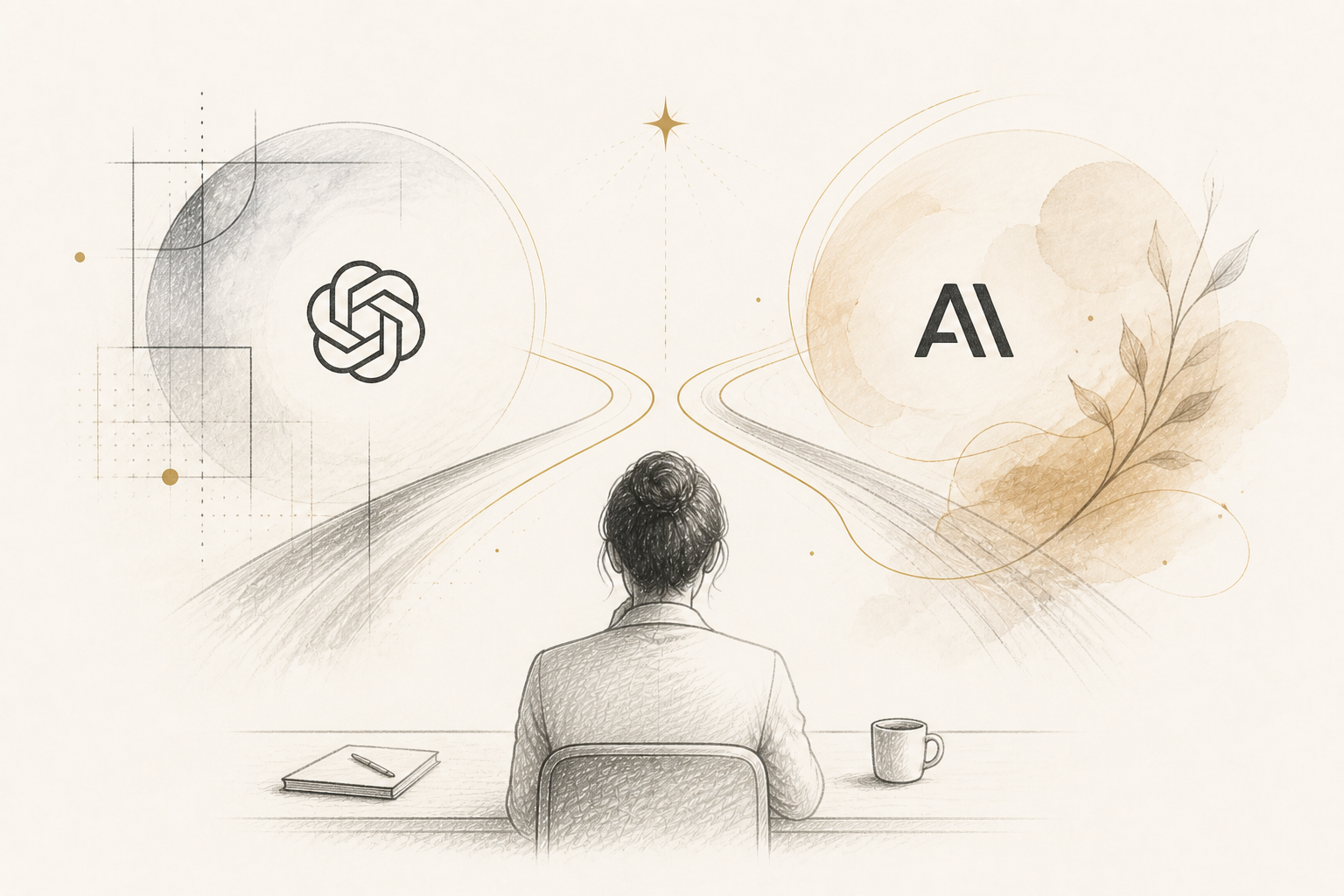
GPT-5 from OpenAI and Claude Sonnet 4.5 from Anthropic both sit at the top of independent benchmarks. Both have enterprise-grade security. Both cost roughly $20 a month at the professional tier. So when a business asks me which one to deploy, the honest answer is rarely "this one." It is "depends on what you need them to do." This piece breaks down where each genuinely wins, where each loses, and how to pick.
The high-level positioning
OpenAI built ChatGPT to be the default AI for everyone — broad, integrated, multimodal, with a vast ecosystem of plugins and connections. Anthropic built Claude as the AI for nuanced thinking, careful reasoning, and long-document analysis — narrower in surface area, deeper in capability per task. Both are excellent. They are excellent at different things.
Where Claude wins
Claude leads independent benchmarks for coding (Claude Code is the most-deployed agentic coding tool in engineering teams globally), nuanced writing (consistently scores higher on instruction-following and tone), and long-document analysis (a 200,000-token context window handles entire contract bundles or annual reports in one conversation). It also leads for careful, multi-step reasoning where accuracy outweighs speed — legal review, compliance analysis, due diligence synthesis. The Projects feature gives Claude persistent memory across conversations, which is particularly valuable for ongoing client work or any task requiring consistent context.
Where ChatGPT wins
ChatGPT is the better default for general-purpose business productivity. Its multimodal capability is broader (voice mode is the leading real-time conversational AI; DALL-E 3 produces high-quality images natively). Its real-time web search is more polished than Claude's research workflows. The Custom GPTs ecosystem and the plugin library mean there are off-the-shelf tools for almost anything. Operator and ChatGPT Agents are further ahead than equivalent Claude features for autonomous web tasks. And the third-party integration ecosystem — Zapier, Microsoft, Google, Salesforce — is significantly broader.
Pricing and tiers
At the consumer tier the products are essentially identical: $20 per month for the professional plan, free tier with limits, enterprise plans starting around $30 per user per month. Claude Team starts at five users and scales to 50 with shared workspaces; ChatGPT Team scales to 149 users. Both enterprise plans add SSO, admin controls, usage analytics, and data isolation. Anthropic is slightly more generous on enterprise context window. OpenAI has a more granular pricing structure for API usage, which matters if you are building products on top of the platform.
Enterprise governance and data privacy
Both platforms now offer SOC 2 Type II compliance, data residency options, no training on enterprise conversations, and granular admin controls. Claude has historically led on a "constitutional AI" approach to safety; ChatGPT has caught up significantly. For regulated industries — finance, healthcare, legal — the practical difference is often integration with your existing identity provider and your existing audit infrastructure. Both are now mature enough that the differentiator is rarely the security model itself.
How to choose
For most mid-market businesses the real answer is "both, for different jobs." Use ChatGPT as the default for general productivity, drafting, multimodal work, and broad integration. Use Claude for the heavy reasoning tasks — long documents, careful analysis, code, anything where the cost of being wrong is high. If you must pick one because of procurement or licence constraints, the question becomes: what dominates your team's daily work? If it is general writing, customer-facing content, multimodal creation, and integration with the broader software ecosystem — ChatGPT. If it is document-heavy analysis, technical work, and structured reasoning — Claude.
Practical buying advice
Run a 30-day pilot with both. Pick five high-frequency tasks across your team — an email draft, a contract review, a financial analysis, a code review, a customer support response. Run each task through both platforms. The right answer becomes obvious within three weeks. Do not rely on benchmarks alone — the gap between top-line benchmark scores and actual fit for your team is large enough that benchmarks should never be the deciding factor.
One final point on vendor strategy: a healthy AI tooling strategy at mid-market scale typically includes both, plus at least one specialist (Perplexity for research, Copilot if you are heavy in Microsoft 365, NotebookLM if you have document libraries to interrogate). Picking one platform and pretending it does everything is a false economy. The marginal cost of running both is small; the marginal capability gained is significant.
Agata Adamczak
Founder, Lumii Advisory · AI Strategy & Digital Transformation
AI Platform Guides
Honest guides to every AI platform
Tool-by-tool breakdowns of ChatGPT, Claude, Gemini, Copilot, and Perplexity — with industry use cases.


Let’s find your light.
Whether you are at the start of your AI programme or deep into it, a single conversation can change its trajectory.