How to Build an AI Business Case Your Board Will Approve
Board approval for AI investment is harder to secure than most expect. Not because boards are sceptical of AI — but because most business cases fail to speak the board's language. Here's how to change that.
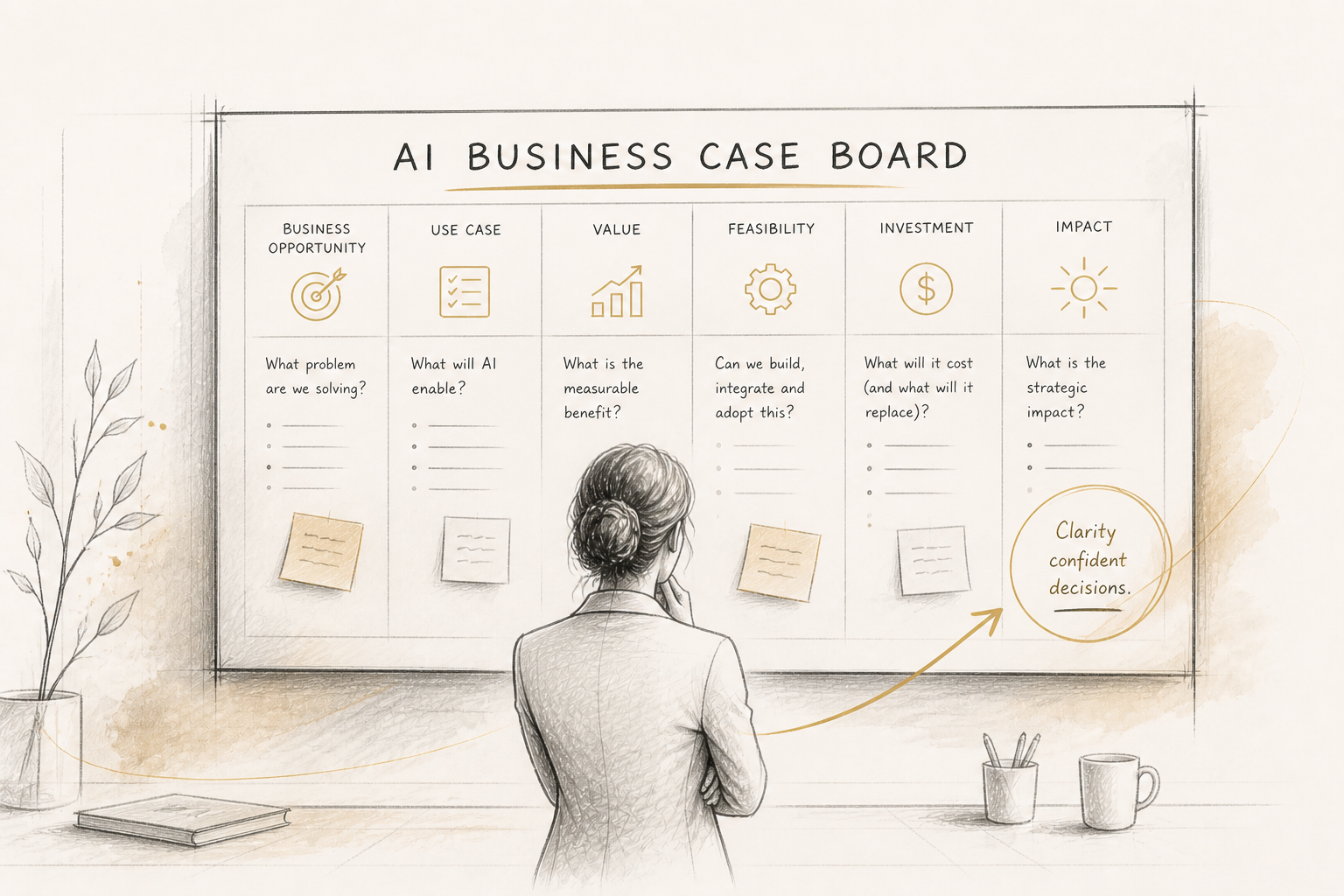
Board approval for AI investment is harder to secure than most technology leaders expect. Not because boards are sceptical of AI — 91% of senior executives believe AI will be critical to business success within five years. It's because most business cases fail to speak the board's language: risk, return, and accountability.
The Three Things Boards Actually Want to Know
After helping numerous organisations present AI investment cases to their boards, I have found that the approval questions almost always boil down to three things: What is the financial return and how confident are we in those numbers? What could go wrong and how are we managing it? Who is accountable for delivery?
A well-structured AI business case addresses all three directly. It does not lead with technology capabilities or competitor benchmarks — it leads with business outcomes, expressed in the language of your P&L.
Building Your Financial Model
AI ROI calculations should include both direct savings and revenue uplift. Direct savings typically cover labour efficiency (time saved on manual tasks, converted to FTE equivalents), error reduction (cost of rework, compliance breaches, customer remediation), and infrastructure savings. Revenue uplift typically includes improved conversion, faster sales cycles, and reduced churn.
Be conservative in your base case. A board that approves a 40% efficiency gain and gets 25% is disappointed. A board that approves a 20% gain and gets 25% becomes an advocate. Conservative, credible numbers are more likely to get approved — and more likely to build trust when you return for the next phase of investment.
Addressing Risk Head-On
Don't wait for the board to raise risks — bring them. Data privacy and security, model accuracy and bias, vendor dependency, regulatory compliance, workforce impact. For each risk, present your mitigation: how you will manage it, who owns it, and what the fallback plan is. Boards that feel you have thought through the risks are far more likely to approve.
Phasing Your Investment
Structure your investment ask in phases. Phase 1 is typically a focused pilot with a defined success metric and a modest budget. Phase 2 is scaled deployment contingent on Phase 1 results. Phase 3 is enterprise-wide with the full business case. This approach reduces the financial commitment at each decision gate and gives the board confidence that you are not betting the farm on a single implementation.
The most successful AI business cases I have seen are not the most technically sophisticated. They are the most commercially rigorous — connecting AI investment directly to the strategic priorities the board already cares about, with clear accountability and credible numbers. That is a language every board speaks.
Agata Adamczak
Founder, Lumii Advisory · AI Strategy & Digital Transformation
Free Ebook
Find Your Light in the Age of AI
The complete 90-day AI strategy system — including how to build the board-ready business case. Free download.



Let’s find your light.
Whether you are at the start of your AI programme or deep into it, a single conversation can change its trajectory.